Embodied AI / Engineering
From Pixels to Physical Actions: The Interfaces That Make Embodied AI Work
Frames, calibration, uncertainty, and timing: the information that has to survive the journey from a camera image to a physical action.
A robot looking at a workbench faces a deceptively difficult question: what, exactly, is it allowed to believe about what it sees? Recognizing a damaged surface is one problem. Establishing where that surface is, how recently it was observed, whether the tool can reach it, and what should happen when the evidence disagrees is a much larger one.
That boundary between interpretation and action interests me more than any particular model architecture. My projects have included robotic arms, industrial computer vision, motion recognition for wearables, and tools for adapting vision-language models. Across those different forms of embodiment, a recurring engineering challenge is translating useful information into a representation that another part of the system can safely act on.
My argument is that the interfaces deserve as much attention as the intelligence on either side of them. A strong model can widen the range of situations a robot understands. Carefully designed interfaces make its understanding inspectable, testable, and connected to the physical world.
1. A plywood repair task makes the problem concrete
I started Empirical Automation with robotic arms for research and later developed computer vision software. The portfolio describes a plywood repair prototype in which visual recognition identified defects, informed by observing human workers. Defect locations were then generated, parsed, and sent to an industrial robot to apply repair paste. That is a useful example because the task connects perception to a visible physical consequence.
The high-level description sounds straightforward: find a defect and repair it. But consider everything hidden inside the word “location.” It might mean the center of a bounding box in a camera image, a polygon on the board surface, a point relative to a fixture, or a target for the robot's tool tip. Those representations answer different questions. Passing one where another is expected can produce a perfectly valid number and a completely wrong action.
The repair objective also includes more than recognizing the right patch of wood. A candidate region needs to be associated with the correct board. Its extent matters, as does the relationship between the applicator and the surface. The robot needs a reachable approach and a permissible motion. Completion requires evidence that material was applied appropriately, rather than an acknowledgement that a movement command was received.
I find this a productive starting point for embodied AI: choose a physical operation, then follow each claim from the sensor to its consequence. The interesting questions appear wherever information changes meaning.
2. Model progress changes the interface requirements
Research has offered several ways to connect language and action. SayCan combines language-based task reasoning with estimates of what a robot's available skills can accomplish. RT-2 takes another approach, representing robotic actions as tokens and training with both robotic trajectories and vision-language tasks. The papers explore different ways to transfer semantic knowledge into physical behavior.
For an engineer, the practical question is where the model's output becomes a commitment. A skill-selection system might propose “inspect this board.” A vision-language model might identify an actionable region. A learned action policy might emit a movement directly. Each arrangement needs a clear account of what downstream components may assume and which decisions remain subject to independent constraints.
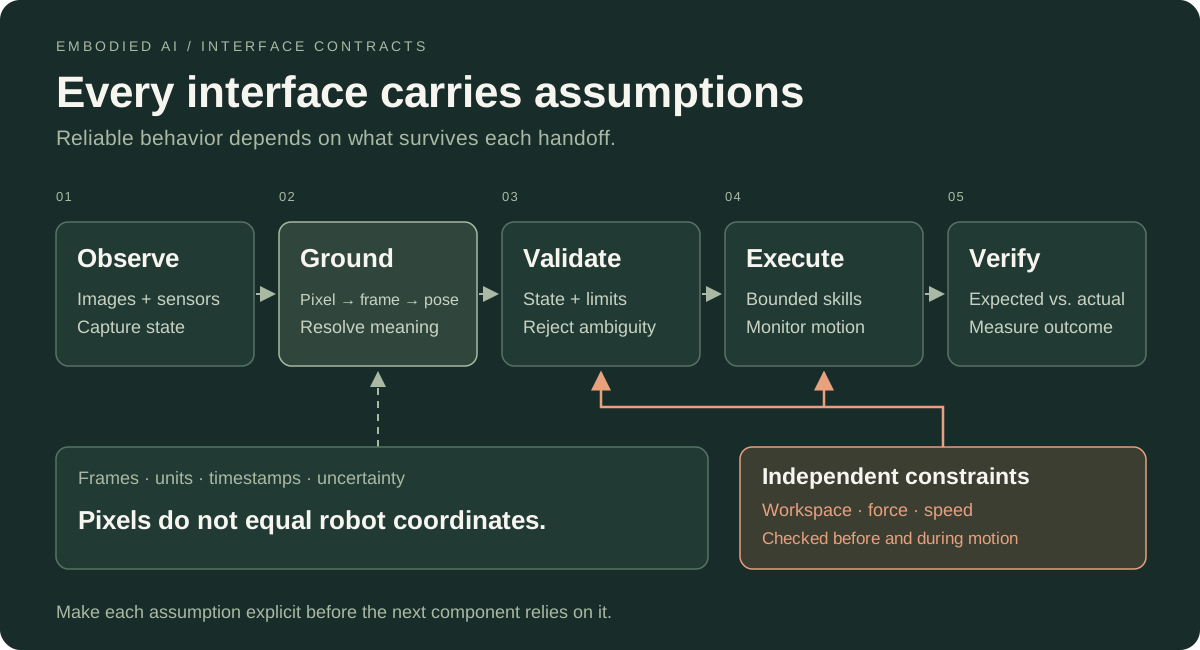
My preference for an industrial integration would be to make those commitments explicit, even when the model learns several stages jointly. An action token still needs an interpretation: its units, reference frame, timing, permitted range, and relationship to the controller. Combining capabilities inside a model does not remove those physical meanings.
There is also a useful distinction between semantic flexibility and operational flexibility. Understanding “fill the damaged patch near the corner” can reduce the effort required to describe a task. It does not establish that every patch near every corner can be repaired with the current tool. A capable language interface should make it easier to state intent while preserving the narrower conditions under which execution is justified.
3. Give every observation a contract
I would start with an observation record that carries its own interpretation. Alongside a defect label or region, it would include a frame identifier, coordinate convention, units, capture time, source image identifier, calibration version, and an account of uncertainty. A downstream consumer should be able to reject an observation without asking the model to explain what it meant.
Some of these fields sound administrative until something changes. A camera is replaced. Images are resized before inference. A tool is exchanged. A fixture moves. If the system silently preserves a coordinate array while losing the conditions that made it meaningful, apparently successful software integration can conceal a physical mismatch.
| Claim | Required context | Useful rejection condition |
|---|---|---|
| “A defect is here” | Image, region, object identity, capture time | Image is stale or board identity is uncertain |
| “Here is a world position” | Frame, units, calibration, surface assumption | Calibration or surface validity check fails |
| “This action is feasible” | Tool, robot state, constraints, scene version | Scene changes or the motion is unreachable |
| “The repair is complete” | Observed postcondition and task identity | Outcome cannot be verified |
The point is to make missing information observable. An empty uncertainty field should not be interpreted as zero uncertainty. An absent timestamp should not mean “now.” Defaults that are convenient in a dashboard can become dangerous when they silently authorize movement.
I would also keep observation, proposed action, accepted action, and observed outcome as separate records. They can share an identifier without sharing authority. This makes it possible to inspect whether an error originated in perception, geometric conversion, validation, execution, or verification.
4. Work through the geometry before trusting the label
Consider a simplified camera-to-robot example. Assume a calibrated pinhole camera, corrected image distortion, and a point whose depth along the camera's optical axis is known. Let the focal lengths be 1,000 pixels, the principal point be (640, 360), the detected image point be (840, 460), and its depth be 1 metre. These numbers are chosen only to make the arithmetic readable.
Back-projection gives x = (u - cx) × z / fx and y = (v - cy) × z / fy. The point in the camera frame is therefore (0.20, 0.10, 1.00) metres. A pixel coordinate has become a three-dimensional point only because we supplied a depth and a camera model. Without them, it describes a viewing ray.
Now suppose the transform from camera coordinates to robot-base coordinates rotates 180 degrees around the x axis, then translates by (0.30, 0.20, 1.20) metres. The rotation changes (x, y, z) into (x, −y, −z). The resulting base-frame point is (0.50, 0.10, 0.20) metres. Stating the direction of the transform matters: applying its inverse would answer a different question.
Even this correctly transformed point is not yet a robot command. It identifies a surface point, rather than a complete tool pose. The applicator needs an orientation, an offset between its tip and the controller's reference point, and a planned approach. A valid endpoint also says nothing about collisions along the route.
A planar board can sometimes support a calibrated image-to-plane mapping instead of per-pixel depth. That choice makes the plane assumption part of the contract. Warping, stacking, or displacement can invalidate it. I would make that assumption visible in both software and the operator interface, and require new evidence when the surface no longer matches it.
5. Carry uncertainty into the decision
Uncertainty should change what the system does. A detection can be semantically convincing and geometrically inadequate. In the illustrative camera above, a three-pixel lateral error corresponds to three millimetres at the assumed depth. That conversion changes with distance and calibration. A bounding box that looks precise on a screen can still be too imprecise for a particular applicator.
Suppose, purely for illustration, that justified bounds for image localization, calibration, and board registration contribute 3, 2, and 2 millimetres along a relevant direction. Adding their worst-case magnitudes yields a conservative 7-millimetre bound for those contributions. Combining them statistically would require a defensible error model; independence should not be assumed because it produces a smaller number.
If an illustrative operation tolerates only 5 millimetres of error, that evidence does not support execution. The next action might be a closer image, a registration check, or operator review. Moving more slowly does not fix an incorrect target. It addresses a different part of the problem.
These bounds also have limits. They do not cover a mistaken board identity, a reversed axis, an unmodeled obstacle, or a failed sensor unless the analysis explicitly includes those cases. I would keep such validity failures separate from numerical measurement error. A small uncertainty estimate attached to the wrong physical object is particularly misleading.
Model confidence deserves the same discipline. A generated sentence saying “high confidence” is not an error bound. Useful uncertainty evidence comes from calibration and evaluation for the task, together with checks that the present situation resembles the conditions under which those estimates were established.
6. Adapt perception without confusing familiarity with reliability
My VLM Tuner project provides interfaces for labeling data, training adaptations, and inspecting inference results. Its public demo uses Qwen2-VL with LoRA. The Qwen2-VL paper describes mechanisms for processing images at varying resolutions and combining text, image, and video information. LoRA adapts a pretrained model through trainable low-rank updates while keeping its original weights frozen.
For a narrowly defined inspection task, adaptation is attractive because the visual distinction may be highly specific: a repairable defect versus a harmless material feature. But I would evaluate the complete application behavior rather than treating a successful training run as evidence of readiness. The relevant question is whether predictions support the downstream physical decision under the conditions that matter.
Dataset design should follow that decision. Include difficult negatives, ambiguous cases, changing illumination, partial occlusion, surface variation, and examples that should trigger abstention. Labels should distinguish “no defect” from “cannot determine.” Otherwise the system may learn to convert inadequate visibility into a confident negative prediction.
I would split evaluation data by board, recording session, and relevant acquisition conditions, rather than scattering near-identical video frames across training and testing. The latter can reward recognition of a familiar scene while hiding weaknesses on new material. Keep the untouched evaluation set separate from the cases used repeatedly to guide adaptation.
There is a safety benefit to a good labeling interface: it can expose disagreement before that disagreement becomes an action. If reasonable annotators cannot consistently identify the permitted repair region, the task definition may need revision before additional training helps.
7. Put action authority at an explicit boundary
Once perception produces a grounded candidate, I would pass it to an action validator with a deliberately narrower role. It checks whether the requested operation fits the current robot, tool, workspace, and task constraints. A model can propose a target or request a skill; it should not be able to redefine the limits used to judge that proposal.
At the motion-control level, there are formal tools for expressing constraints. Ames and colleagues' work on control barrier functions describes conditions for keeping modeled system states within a defined admissible set, including integration with optimization-based controllers. Such guarantees depend on their mathematical assumptions, the system model, and implementation conditions.
The engineering implication I draw is to connect each claim to its scope. A geometric workspace check covers specified geometry. A controller constraint addresses specified dynamics. Neither establishes that a vision model understood an unfamiliar scene correctly. I would document what each layer checks and how the system responds when that layer cannot establish its condition.
Independent protective measures need their own treatment for the actual workcell and hazards. A software diagram cannot establish their adequacy. Within the application architecture, however, it is useful to ensure that a missing calibration, stale scene, or rejected action produces a defined state transition. “Try again with a more persuasive prompt” is not an appropriate response to a failed physical precondition.
8. Treat time as part of geometry
A position without a time can be an obsolete position. Imagine an illustrative board moving at 0.10 metres per second. During 200 milliseconds between image capture and use, it moves 20 millimetres. A geometric estimate can be correct for the captured image and still be wrong for the moment of execution.
I would therefore distinguish capture time, inference completion, plan acceptance, and execution start. If motion is tracked, the prediction needs a time horizon and an uncertainty model. If the task assumes a stationary board, that assumption should be checked. A freshly generated response does not imply that its underlying image is fresh.
State changes can invalidate approved work too. Opening a fixture, exchanging a tool, or moving an object should invalidate the affected plan and any operator approval attached to it. Approval belongs to a particular proposal in a particular scene. It should not survive arbitrary changes because the interface still displays an “approved” badge.
Recovery introduces another timing problem. After a communication interruption, a retry may duplicate an action that physically happened but whose acknowledgement was lost. I would use task and action identifiers, track execution state, and inspect the physical postcondition before resuming an uncertain operation. Applying paste twice is different from requesting the same database row twice.
9. Evaluate the transitions, then the complete task
My proposed evaluation would begin by testing each interface with controlled inputs. Feed geometry conversion known points and transformations. Give the validator stale timestamps, unknown frames, missing units, tool mismatches, unreachable targets, and changed scene versions. The aim is to observe whether invalid evidence is rejected for the correct reason.
Then evaluate the full chain using task-level outcomes. For repair, a useful assessment would include localization error in physical units, unacceptable application outside the intended region, missed defects, inappropriate acceptance, successful abstention, and whether completion was verified. Each metric needs a clear denominator. Reporting only completed repairs can hide failures that prevented completion or should have prevented execution.
I would explicitly include ordinary variation and deliberate disturbances: altered lighting, partial occlusion, camera displacement, incorrect calibration selection, delayed observations, and interrupted communication. Some cases test robustness; others test whether the system recognizes that its operating assumptions have failed. Those are different outcomes and should be reported separately.
Outcome verification needs an evidence source suited to the effect. A controller reporting that an applicator reached its endpoint does not establish that paste was dispensed or adhered to the intended region. A proposed verification stage might combine a fresh image with a process measurement, while keeping disagreement visible. If both measurements depend on the same obscured camera view, agreement between their software outputs adds little independent evidence.
Simulation and recorded replay are useful for exploring these cases without immediately involving hardware. Physical evaluation remains necessary for effects the model does not capture, such as compliance, contact, dispensing behavior, and real sensing conditions. Moving between these stages should involve explicit evidence requirements rather than the appearance of a convincing demo.
The resulting report should make causal diagnosis possible. If the final placement is wrong, was the target misidentified, transformed incorrectly, observed too early, planned incorrectly, or executed poorly? An end-to-end score helps compare systems; interface-level evidence helps improve them.
10. Make the operator interface show the physical commitment
A natural-language interface can hide complexity so successfully that it hides the wrong things. An operator asking for a repair should be able to inspect the selected board, proposed region, relevant uncertainty, intended approach, and conditions that remain unresolved. The preview needs to explain what the robot is preparing to do.
My earlier work in motion recognition and wearable technology also makes me attentive to the difference between sensing a person's movement and understanding their intent. A sensor stream describes measurements. A classification interprets them. An interface decides how much authority to grant that interpretation. Keeping those stages visible is useful whenever software has consequences beyond a screen.
For the repair example, I would prefer an overlay tied to the actual source image, with its capture time and selected calibration, alongside a view of the proposed tool motion. A textual summary can explain unresolved conditions, but it should not replace the underlying evidence. If the system is uncertain about the board edge, show that uncertainty where the operator can inspect it.
Good feedback also distinguishes “request received,” “plan accepted,” “motion finished,” and “repair verified.” Combining those into a single success indicator encourages misunderstanding precisely when the operator needs a reliable account of the system's state.
11. Interfaces are also how embodied learning scales
The Open X-Embodiment collaboration provides standardized robotic datasets and explores policies trained across different robots. Its reported cross-platform transfer is an important research direction. It also highlights a practical problem: experiences become easier to combine when their representations have sufficiently clear meanings.
For my own future systems, I would preserve those meanings in the data collected during operation. Store the image and its provenance, the grounded observation, the proposal, the checks applied, the executed action, and the observed result. Keep rejected proposals and unresolved outcomes too. A dataset containing only successful actions cannot explain where the system lacked evidence or needed help.
This record supports both learning and engineering accountability. A new perception model can be evaluated against earlier observations. A calibration change can be traced to the actions that used it. An operator can understand why a seemingly simple request paused. The same information that enables diagnosis can make later training examples more useful.
I am optimistic about models that connect visual understanding, language, and action. The practical opportunity is substantial. My strongest design preference is to make every transition explicit enough that a better model can be introduced without making the physical system harder to understand. The path from pixels to action becomes dependable when each component states what it knows, what it assumes, and what evidence the next component needs.
Sources and further reading
- Ahn et al., Do As I Can, Not As I Say: Grounding Language in Robotic Affordances (first submitted April 4, 2022). Research on combining language-based planning with grounded robotic skills.
- Brohan et al., RT-2: Vision-Language-Action Models Transfer Web Knowledge to Robotic Control (July 28, 2023). Research on learning action representations alongside vision-language tasks.
- Wang et al., Qwen2-VL: Enhancing Vision-Language Model's Perception of the World at Any Resolution (first submitted September 18, 2024). Technical report for the model family used in the VLM Tuner demo.
- Hu et al., LoRA: Low-Rank Adaptation of Large Language Models (first submitted June 17, 2021). The low-rank adaptation method.
- Ames et al., Control Barrier Function Based Quadratic Programs for Safety Critical Systems (first submitted September 21, 2016). Formal treatment of control constraints under stated assumptions.
- Open X-Embodiment Collaboration, Open X-Embodiment: Robotic Learning Datasets and RT-X Models (first submitted October 13, 2023; version 9, May 14, 2025). Standardized datasets and research on learning across robotic embodiments.
Written by James Schuback. Explore the projects behind these ideas or get in touch.
Continue reading: Evaluating Safety Boundaries for LLM-Controlled Robotic Systems · AI Productivity Needs a Verification Loop · Adversarial Robustness & AI Control